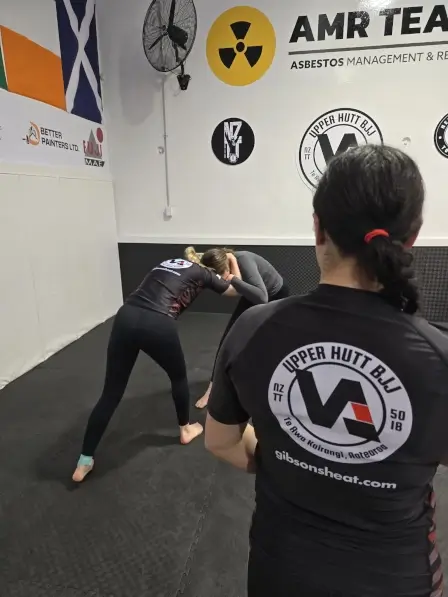
Brazilian Jiu-Jitsu (BJJ) is one of the most empowering martial arts for women. Unlike many sports, BJJ focuses on technique and leverage rather than size and strength, making it highly effective for self-defence. Women quickly discover that they can control larger and stronger opponents through skill, giving them confidence both on and off the mats.
Beyond self-defence, BJJ builds fitness, resilience, and mental toughness. Training develops problem-solving under pressure, stress relief, and a strong sense of community. Women often find the supportive environment on the mats helps them push boundaries, achieve personal goals, and feel a greater sense of empowerment in their daily lives.
At our academy, we are proud to see teenage girls training alongside women in our dedicated women’s classes. This creates a unique space where younger students can learn from older role models while building friendships and developing their own confidence. It also helps to normalize female participation in martial arts, inspiring the next generation to pursue their potential without limitation.
Brazilian Jiu Jitsu is more than a sport—it’s a tool for empowerment, self-discovery, and lifelong growth.
Key Statistics in New Zealand
Violence against women is a pressing issue in New Zealand. Recent data shows that assaults, intimate partner violence, and sexual violence continue to affect large numbers of women—often with lifelong impacts. This makes programs such as women’s Brazilian Jiu Jitsu (BJJ) not only valuable but essential.
- About 24% of women have experienced intimate partner violence (IPV) offences in their lifetimes. Manatū Wāhine Ministry for Women
- When non-violent abuse such as controlling behaviours or economic abuse is included, the lifetime rates jump significantly. For example, controlling behaviour among women increased from 8.2% in 2003 to 13.4% in 2019. Economic abuse also nearly doubled in the same period. Manatū Wāhine Ministry for Women+2Manatū Wāhine Ministry for Women+2
- One study (He Koiora Matapopore, 2019) found that 55.8% of ever-partnered women reported at least one form of intimate partner violence (physical, sexual, psychological, or economic). Rates were higher among Māori women. PubMed
- Sexual violence among teens in New Zealand is particularly alarming: almost 30% of girls aged 12-18 report having experienced sexual violence, well above the global average. CENTRIST+1
- Reporting remains low. For example, 92% of sexual assault offences are estimated to go unreported to police. Manatū Wāhine Ministry for Women
Why These Trends Make BJJ Especially Important
- Self-Defence & Physical Confidence
With high rates of violence (especially partner violence and sexual violence), knowing how to protect oneself physically is a powerful tool. BJJ teaches techniques that allow someone to defend themselves even against physically larger or stronger attackers by using leverage, positioning, and joint locks. - Mindset & Boundary Setting
Beyond physical techniques, BJJ builds awareness, assertiveness, and confidence. Women and teens learn to set clear boundaries and develop mental resilience—important in both preventing and dealing with abuse or harassment. - Safe Community and Role Models
Having dedicated women’s classes (including teenage girls) creates a space where people can learn from each other, see strong role models, and realize they are not alone. For teens especially, this can interrupt cycles of vulnerability and help build a foundation of respect and self-worth. - Reduced Fear and Increased Independence
Knowing self-defence can reduce anxiety around personal safety. It helps women and young people feel more secure in daily life—walking, commuting, socializing—without feeling constantly vulnerable.